Posts

Two Books About the Kivy GUI Framework

Image
The Kivy Python GUI framework is intriguing. Not only it’s cross-platform but also supports Android. Java is too verbose and low level for me and Kivy is an opportunity for developing native Android apps without leaving Python. Outside of the Kivy project documentation, there are few third-party advanced tutorials that go in more depth than the official tutorials. So, before diving into the code of the Kivy demos, I wanted some books to explore more features and get a broader picture of the framework and what it can do. I found two potentially interesting books: Building Android Apps in Python Using Kivy with Android Studio: With Pyjnius, Plyer, and Buildozer by Ahmed Fawzy Mohamed Gad (Apress, 2019), and Kivy - Interactive Applications and Games in Python - Second Edition by Roberto Ulloa (Packt, 2015). I read both and here are my impressions. Building Android Apps in Python Using Kivy with Android Studio I had much hope for Building Android Apps in Python Using Kivy wi...

Making Your Own Book Cover Is A Publishing Taboo

Image
Self-published book authors are supposed to have many skills. These skills draw on a diverse variety of fields such as marketing, book formatting and typesetting, business, audio and video production, social media management, intellectual property, software, and web design. All this on top of mastering writing and the domains the authors cover. Along with the books, these skills lead authors to produce additional content and artifacts like websites, email newsletters, ebooks files, podcasts, videos, and many more. But authors are strongly, very strongly discouraged from making their own book covers. To the point it’s a taboo. The recommended way is to hire a professional artist or cover designer. It’s sound advice as a bad cover can significantly reduce sales. But I don’t see why authors can’t learn to design covers the same way they can, and have to, learn to create the other content and artifacts. And, for some genres like non-fiction and technical works, a perfect cover ma...

Lenovo Tab E7 Tablet: First Impressions

Image
I bought a Lenovo Tab E7 Android tablet. It was sort of an impulse buy after seeing the device on display at a consumer electronics store and realizing how cheap it is. A buying decision made easier by some Amazon credit I had around. I got the 16 GB version for €74.99 at Amazon. But there are other reasons I wanted a tablet. The home screen of my Lenovo Tab E7 tablet. Why I got a tablet I owned and loved the Nexus 7 tablets, both the original 2012 and the 2013 version. When later getting the massive Nexus 6 phablet with its beautiful large screen, I began using the Nexus 7 less and less. When Google stopped providing system updates, I sold the remaining unit I still had. Since then tablets have apparently gone out of favor with Android users. And manufacturers significantly cut down on the development and production of new models. But I have always loved the slate form factor, particularly 7” tablets . These tablets are small enough to be compact, but with a larg...

The Google Product Experts Berlin Meetup 2019

Image
I attended the Google Product Experts Meetup 2019. The event, which took place from October 21 to 23 in Berlin, Germany, is one perk of the Google Product Experts Program. Waiting for the opening session of the Google PE Berlin Meetup 2019. The Google Product Experts Program The members of the Product Experts Program , i.e. the Product Experts or PEs, are volunteers who help the users of Google products in the official support venues such as the community forums. To assist the users, we have some additional tools and access to Google for reporting bugs, escalating issues, and providing product feedback. Google invites the PEs to the program events and covers the travel and accommodation expenses. Another perk of the program is the opportunity of testing new products or features. The Berlin Meetup The PE program holds at least an event every year. Google rotates between global summits, which usually take place in California and gather PEs from all over the world, regi...

How to Use Kivy on Repl.it

Image
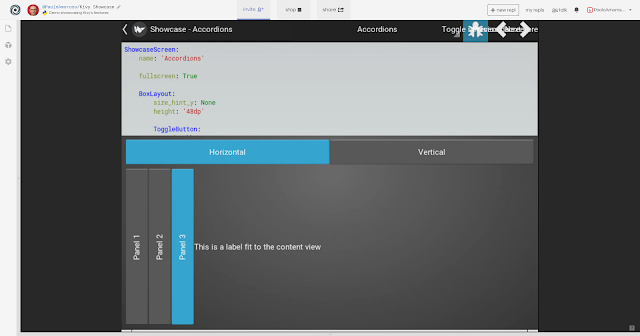
I made the Kivy  Python cross-platform GUI framework work in a GFX REPL on Repl.it . Repl.it is a multi-language cloud IDE with good support for Python. To use Kivy on Repl.it, just create a Pygame REPL, which is among the Kivy dependencies, and install Kivy with the package manager or by adding kivy to requirements.txt . Starting such a REPL in a new session takes a while to download and build the required libraries, at least several minutes. So be patient. This REPL runs the Kivy Showcase , a demo app that showcases some of Kivy’s features. The demo works fine except for a few overlapping widgets in the top bar. And it has some latency issues, but the poor performance is mostly a consequence of the experimental state of GFX. If you adjust the handles along the edges of the REPL panes to close all the panes except the app’s, you can use most of the web page area. Here’s a screenshot of what it looks like. I can’t wait for GFX to support running graphical apps as a website...

Experimenting With Webmentions and Blogger

I’m experimenting with some IndieWeb features on my Blogger blog, particularly webmentions. Webmentions is a web standard for merging the reactions to a blog post across the web. The reactions typically appear as comments to the original post and link back to the sources. I followed the IndieWeb Blogger tutorials for adding to my blog an h-card microformat and support for webmentions. It’s pretty easy. For example, adding webmentions through Brid.gy requires adding just one line of code to the blog’s template. I originally set up Brid.gy to listen to webmentions from Twitter. This works great but, when a tweet has a link to a post of my blog, the full text of the tweet is published as a comment. Copying all the text of other users’ tweets makes me uneasy, especially considering those users may not be aware of it. Therefore, I turned off listening to webmentions from Twitter and deleted the Twitter reactions Brid.gy had initially added as comments to my posts. The blog is...

Hello, Planet Python!

Image
Planet Python is now syndicating the posts about Python of my blog. Thanks to the project maintainer Bruno Rocha for letting me join. You may think of Planet Python as the all-you-can-eat source of Python content. It’s an aggregator of dozens of blogs, podcasts, and other resources on the Python programming language. It syndicates posts that cover Python or are of interest to the Python community. Planet Python is a terrific resource for learning the language and keeping up with what’s going on in its ecosystem. I highly recommend that you subscribe to the RSS feed of Planet Python . If you’re reading this on Planet Python, hi there! About me I’m Paolo Amoroso , an Italian astronomy and space popularizer, a Google expert, and a podcaster . I’m a Python beginner as I started learning the language in December 2018. But I have been a hobby programmer since the home computer revolution of the early 1980s. And I have always had a soft spot for programming languages, paradigms...