Posts

Showing posts with the label Python with Replit

Publishing Python Documentation to Read The Docs With Jupyter Book
Image
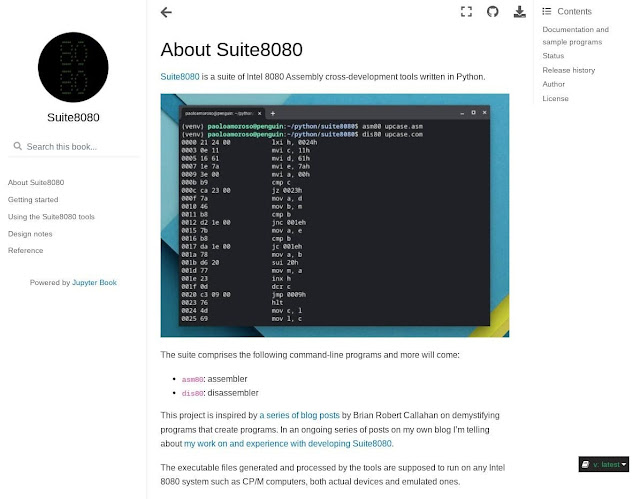
I published the documentation of Suite8080 , a suite of Intel 8080 Assembly cross-development tools I’m writing in Python with Replit. The Suite8080 documentation website built with Jupyter Book and Sphinx and hosted at Read The Docs. Like many Python projects, the documentation comprises a website hosted at Read The Docs. But, unlike most projects, I didn’t use Sphinx directly to generate the website. Instead, I created the documentation with Jupyter Book by The Executable Book Project, well known for Jupyter Notebook. Jupyter Book is a new system for producing publication-quality books and documents for software and research projects. Jupyter Book is significant and promising because, by building on top of Sphinx as a backend and offering a Markdown-based formatting language, it hides the complexity of Sphinx and reduces friction when writing documentation . Before this project I checked out Sphinx directly, but its arcane formatting language and complex setup didn’t make me go fa...

Python with Replit: A Journey in the Cloud

Image
Can I use only Replit for all my Python development? It’s what I set out to find. Follow along my journey to coding in Python on Chrome OS only with the tools and resources of Replit . I want to learn to live off the land in Replit; to develop, test, check into version control, run, document, deploy, and host Python code with Replit. I’ll share my experiences in Python with Replit , a blog post series documenting my ongoing efforts. A Python REPL in Replit on my ASUS Chromebox 3. This is not a philosophical quest for cloud purity or a “use only brand X for 30 days” blog challenge. It’s rather the realization of how much my tools shape the way I work. When in Chrome, do as the chromies do. I want Replit to be my main Python environment, figure out how to work around its limitations, and push the boundaries of what it can do. I’m a hobby programmer and a Python beginner, not a professional developer. These constraints define the journey and frame my setup and tooling decisions. Why use R...

A NASA TV Still Frame Viewer in Python

Image
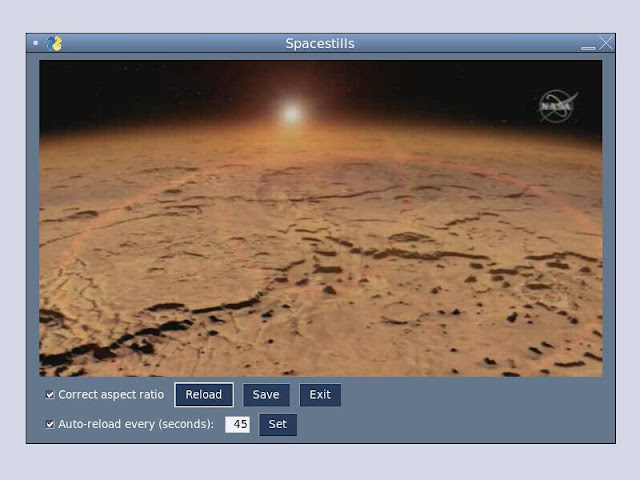
I wrote Spacestills , a Python program for viewing NASA TV still frames. The main window of Spacestills running on Replit. As a hobbyist wishing to improve my Python programming skills, for some time I’ve wanted to work on learning projects more substantial than code snippets , throwaway tools, or short scripts. Spacestillschecks several boxes. The problem domain is one of my primary interests, space exploration. At about 350 lines of code, it’s a non-trivial system with a GUI. It accesses the network to download data from the web. Finally, the program relies on a few Python libraries. About the program Spacestills periodically downloads NASA TV still frames from a web feed and displays them in a GUI. The program allows to correct the aspect ratio of the frames and save them in PNG format. It downloads the latest frame automatically and gives the option to reload manually, disable the automatic reload, or change the download frequency. As a learning exercise, Spacestillsis a basic pro...